

Pardon our new appearance, we just moved our newsletter over to Substack for a few reasons:
We were gaining too many new followers, and…
We kept being marked as spam because our last email service was “shoddy” and “bug-ridden.” I’d put a ton of work into this thing and then there’d be this big red alert on the top, scaring people off:

Yea, sure. Looks real safe. We did you a favor and left for a more legit service; please pay it forward by making sure to like, share and leave a comment with your SSN and mother’s maiden name.
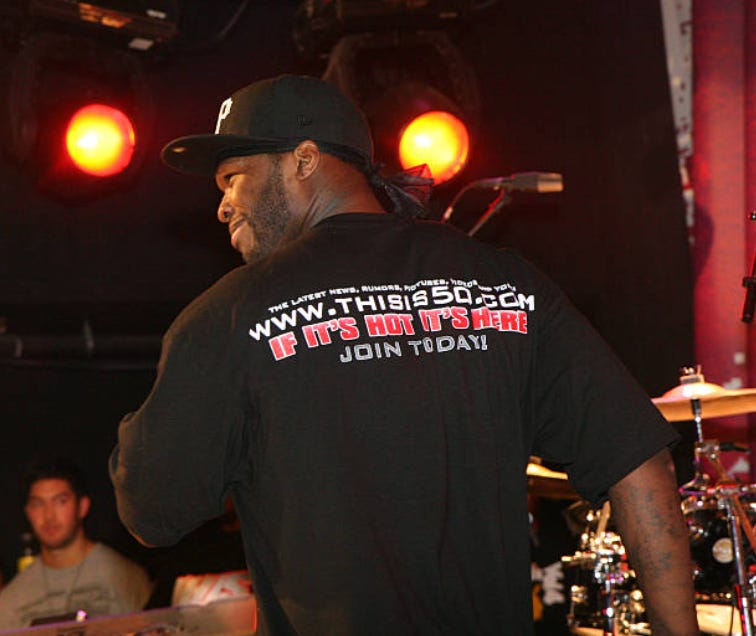
We have a new episode of The Blog Era podcast out today! Our second to last one. If you don’t want any spoilers, just catch up and don’t scroll any further than this picture of Paris Hilton enjoying a 50 Cent/Lloyd Banks performance. (Note their ThisIs50 shirts. Scroll down for a view of the back.)
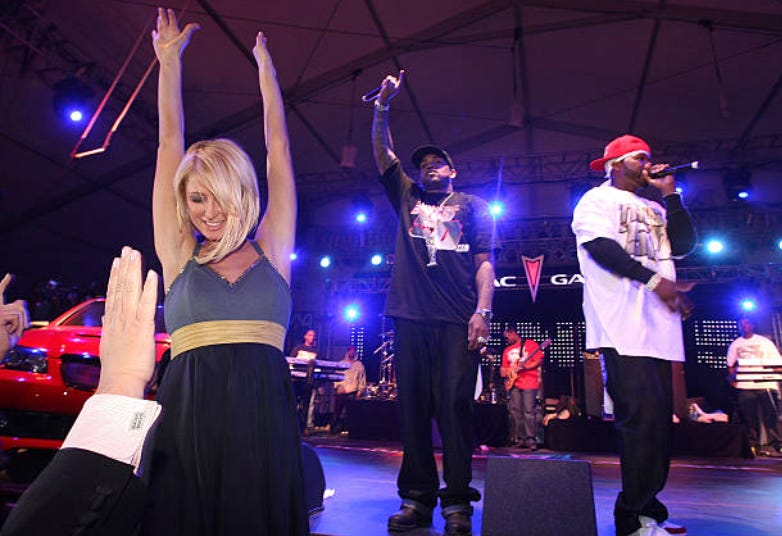
People always wonder why the Blog Era ended. As we’ve discovered, it’s a death by a thousand cuts. Like, technology would always make it incredibly hard to compete. It’s just that all of this starts with a machete.
In trying to tell this generation’s story of the American dream realized and stolen away in the most dynamic way possible, we always hoped we could come close to that feeling HBO Sunday nights give you, where every week feels built-upon. If the 8th episode felt like things couldn’t get lower, then the 9th is where you find out there’s a trap door.
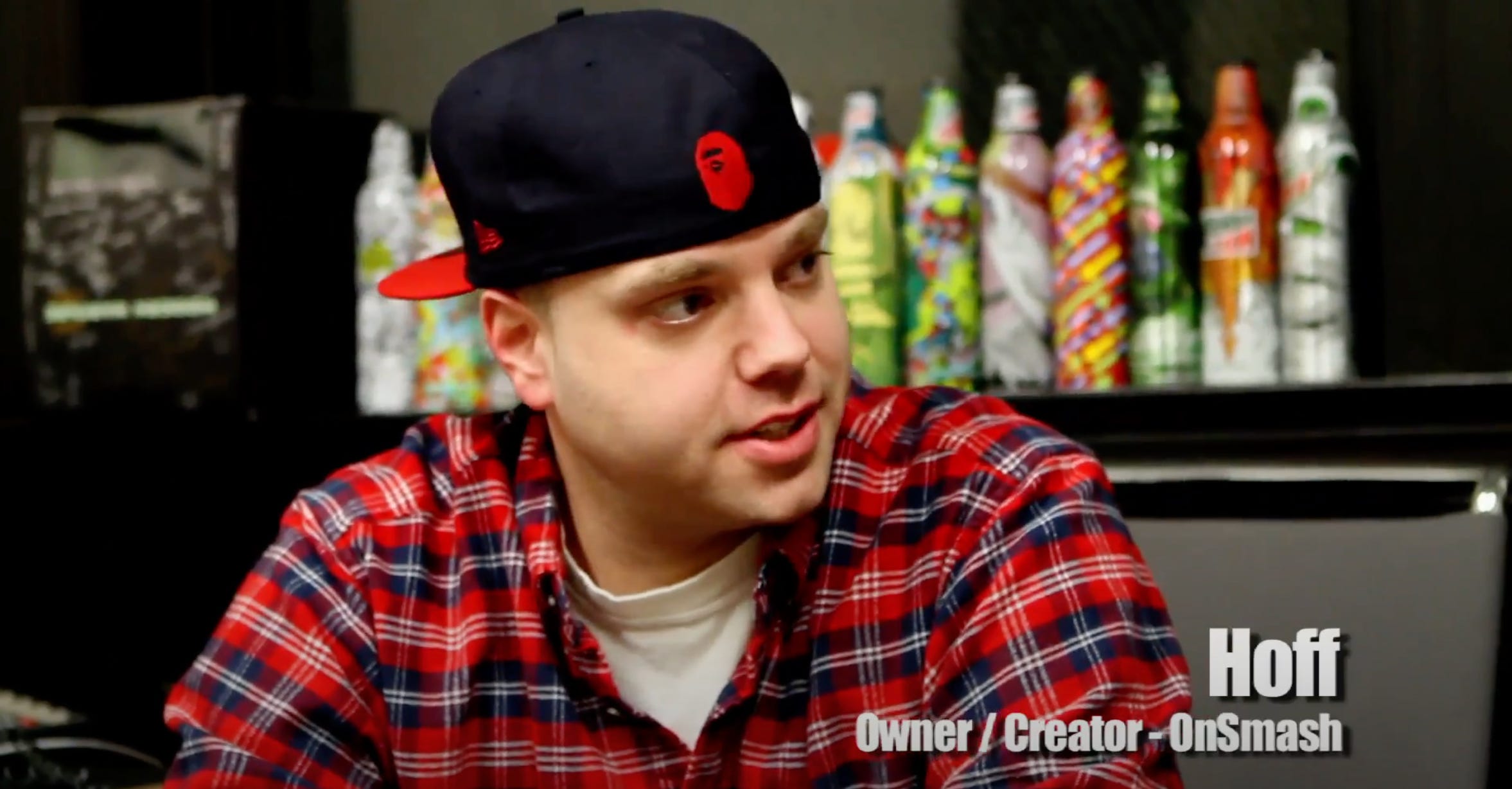
This is Hof, the owner/creator of OnSmash, in January 2011 — six weeks after his site was seized by ICE and the Department of Homeland Security.
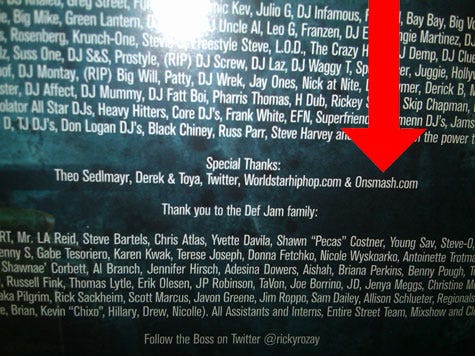
OnSmash - run by Hof, with the help of thekidLEGEND, Young Legend and others - was crucial to the come-ups of many artists in the mid-2000s: Kid Cudi, Action Bronson and Tru Life are just a few examples. Here’s the liner notes of Rick Ross’ platinum-selling 2010 album, Teflon Don, where OnSmash.com is thanked before Def Jam.
As Hof details throughout the series, OnSmash acted responsibly and did right by the labels: when artists, their managers and their marketing teams reached out with mp3s and zShare links, OnSmash would post them. When the legal department - sitting on the same floor as those label reps - sent cease and desist letters, those same links would come down. And OnSmash isn’t exceptional in that, because that’s how everyone in the NMC acted, and there were dozens of other blogs who did the same dance. I don’t think anyone speaks to this strange arrangement as well as NahRight’s Eskay in the 8th episode:
Look, that’s just the dysfunction of any big industry, any big corporation. One hand not knowing what the other hand is doing. But I think really it speaks on the lack of vision on the part of the music industry not being able to see ‘Hey, this format is tailor-made for what you guys do. It’s basically free promotion.’ I understand that there are copyright issues at play here, but you need to figure out a way-- it just blows my mind that there was nobody at these labels that could figure out a way to work with people on a level that it would be beneficial to both parties you know?
OnSmash, while influential, doesn’t get the traffic that many of the other sites do: it’s far eclipsed by 2DopeBoyz, Rap Radar, Miss Info, NahRight, to name a few. And DaJaz1 is an even smaller blip, though it is a crucial part of the New Music Cartel; Splash has a lot of relationships from his days running around with DJ Clue and is able to partner with artists to premiere songs within this group of sites.
On Thanksgiving Day 2010, the websites for OnSmash, DaJaz1 and the hip-hop forum RapGodfathers.com go down. They just simply can’t be accessed. Only later does this image go up:
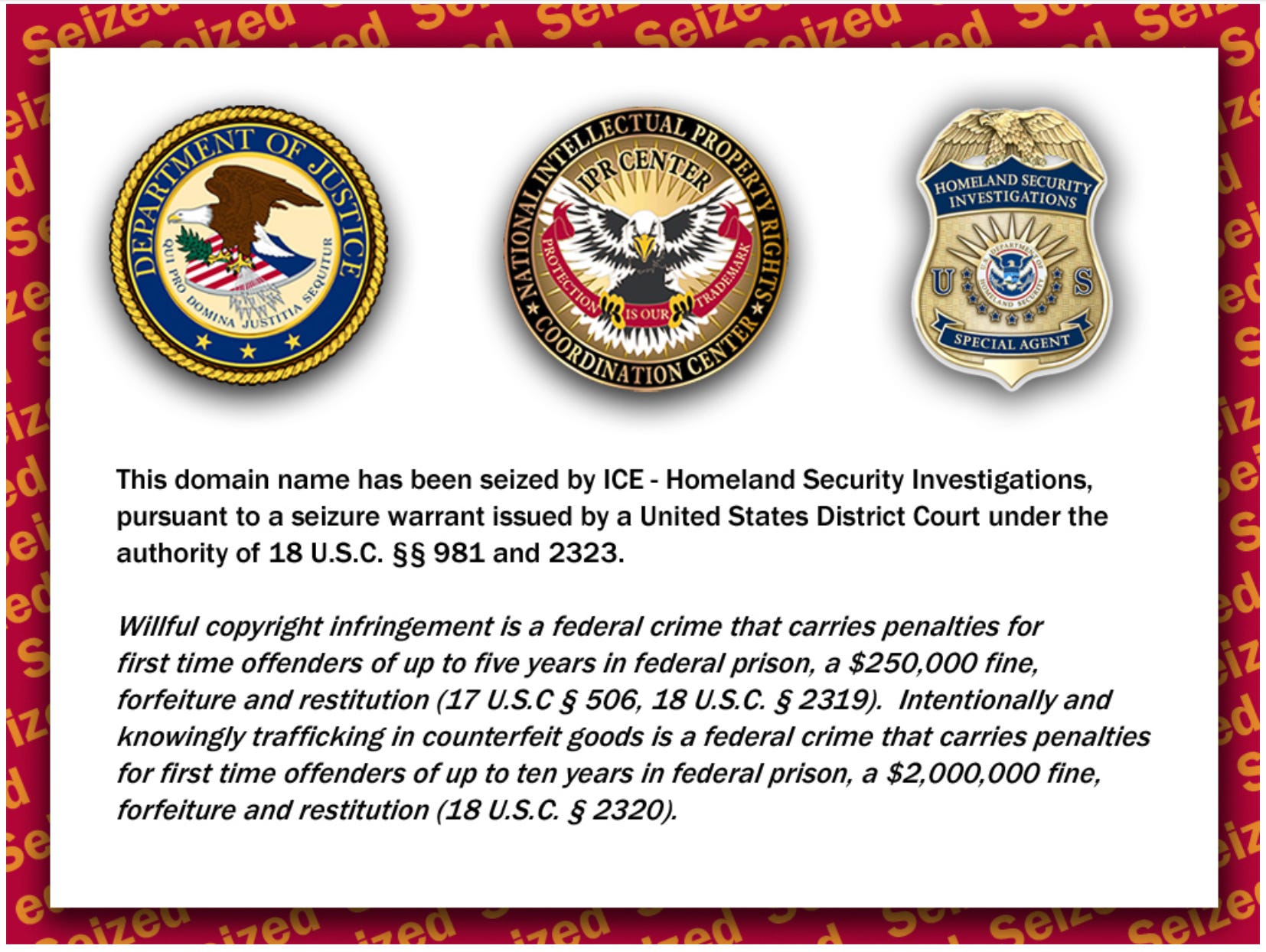
And that’s terrifying. People, including us, like to compare the seizure of these three sites to DJ Drama and Don Cannon getting taken down for RICO violations in 2007. The difference is, Drama was on top of the world, the biggest DJ at the time. OnSmash was making $200-400 a month.
The other 79 websites largely included scammers and counterfeiters that at least sorta fit within the government’s purview? They were selling fake designer handbags, though again, these were small-time operations, the kind you’d find on Canal Street.
So what was the point? Why these websites? Why this, uh, splashy presentation on Cyber Monday? And that’s an answer that seems to elude…everyone. To this coalition of government bodies and industry organizations - ICE, DHS, RIAA, David Benjamin’s UMG and others - these were just names on a board: RapGodfathers was cited for posting Lil B’s Red Flame mixtape, which makes no sense because Lil B wasn’t signed to anyone and never put it up for sale. It also wasn’t even hosted by RapGodfathers, but uploaded to zShare, YouTube and DatPiff, where it could be downloaded. OnSmash was taken down for “Mr. Rager,” a song by Kid Cudi, whose team would regularly give OnSmash exclusives to get Cudi’s buzz up.
Splash got his website back after a year, after suing the government, but never received an explanation in return.
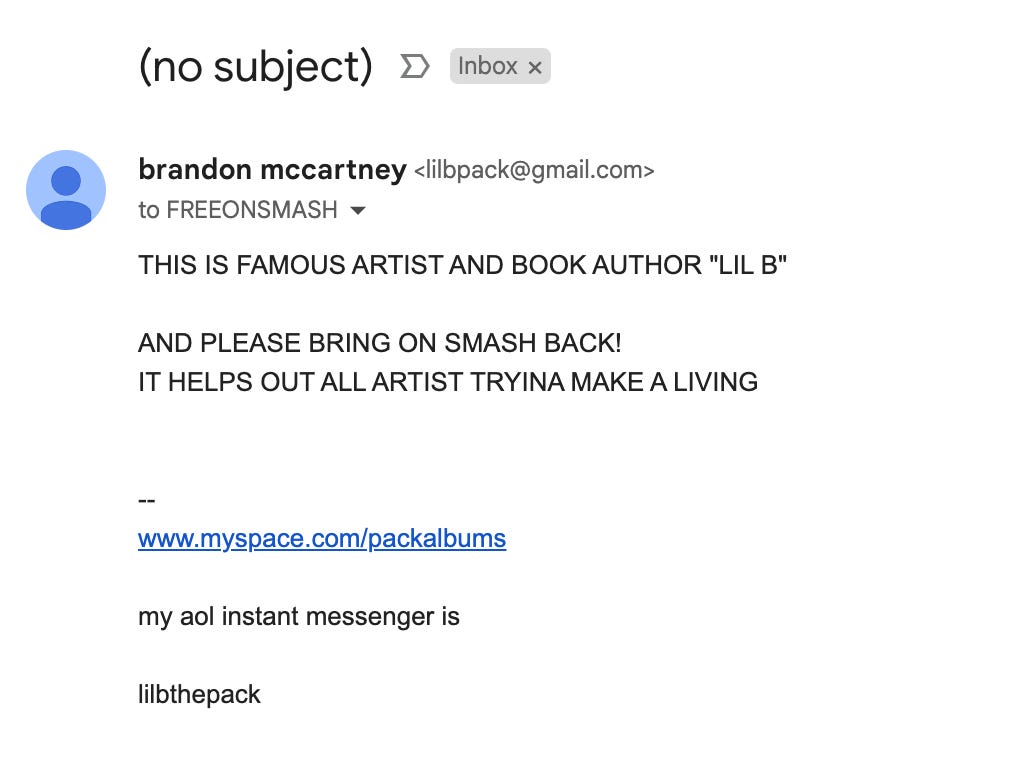
For Hof, the process was much less expensive - he didn’t sue - but it was more drawn out, and became an rallying point for the internet with #FreeOnSmash trending. Dozens of artists tweeted about the site’s positive influence on their careers, from Jim Jones to Kendrick Lamar. In fact, here’s an email that Lil B sent to FreeOnSmash@gmail.com a week after Thanksgiving 2010:
But it took five years — and with little fanfare, OnSmash was returned to its rightful owners. And that was it. Here’s the NYTimes writing about it.
When asked about the return of OnSmash…Matthew Bourke, a spokesman for [ICE], said that after working with the Justice Department, “it was determined there was not enough evidence to seize the websites.”
Cool.
Hof never rolled over on anyone. He never threw anyone under the bus. He was a regular guy from Long Island who grew up loving hip-hop and earned his way into the business, as one of the earliest digital staffers at Def Jam. His website was a passion project to represent for artists who didn’t have the attention, but should have. Not only had Hof’s business been taken from him, but he feared he’d be blackballed by the industry he truly loved. Privately, executives told Hof that of anyone, they were sorry this happened to him. This was the thanks for his good work.
Maybe even more devastating is what we learn about NahRight in episode 9.
Since the invention of Napster, the industry had a massive problem. If songs weren’t getting leaked from their own distribution plants, they were being sold by Apple for the better part of a dollar. And so the blogs were good because, as long as music was free, it may as well be a marketing tool — and no place was better for discovering and breaking new artists than these blogs. Many people did well and even got rich from this system, as we lay out in the first six episodes: The Cool Kids independently cleared $1.4M in 2008. A post-Warner, pre-Atlantic Wiz and his team got arrested on $3M bail — and paid it off without a problem. With the help of the Complex Media Network’s ad sales department, Eskay and the 2DopeBoyz were able to buy themselves houses. So, there was a lot of money up for grabs. It’s just that some of it wasn’t coming through the labels.
And there was a lot of pressure coming from the labels to get that money back. In June of 2011, on the recommendation of David Benjamin and other entertainment industry heavyweights, GroupM, a multi-billion dollar media-planning and ad-buying outfit, added 2000 websites to a blacklist. The thought was, any website illegally hosting copyrighted material would no longer be paid for it, not by any respectable company. But again, the people putting together this list were imprecise in how they went about it: on top of the blogs, other sites included were Complex, Vibe and ThisIs50 — the official website of 50 Cent, a marquee label artist under David Benjamin’s protection!
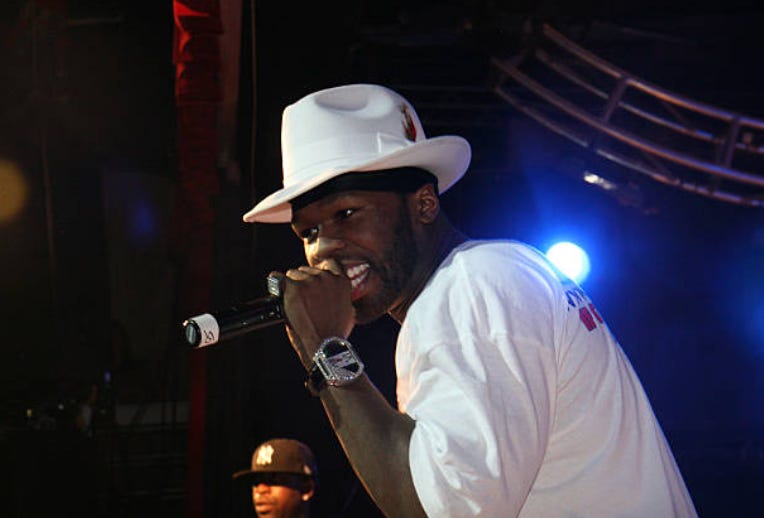
Fine, you made it this far, here’s another picture of 50 wearing the ThisIs50 shirt, but this time with a fedora:
In 2007, NahRight was signed to the Complex Media Network, where its traffic - enormous and growing - helped save Complex, whose executives had just taken a massive pay cut in order to not cut anyone’s jobs. And for years, that was a largely good relationship: a lot of money was made for all parties involved. We could go over what we talk on the podcast, discussing how that partnership evolved and worsened to the point that the two websites ended up in competition with one another — but that’s just business. Eskay could’ve done some things better, and so could Complex.
We all know the blogs didn’t end on one big day. OnSmash as we knew it was taken on Thanksgiving 2010; 2DopeBoyz still operates today. Many others came and went, evolved with social media or died under its crashing waves. But the strangulation of The Blog Era truly came not just at the hands of David Benjamin, but Eskay’s partners.
And that’s heartbreaking.
Complex - in 2011 a money-making factory that was fielding calls to sell around the clock - knew they had to get themselves off the GroupM blacklist. Their business wouldn’t survive - or sell - if they didn’t. So then-CEO Rich Antoniello set out to establish an easy and effective relationship with David Benjamin; in short order, they came to an agreement on moving forward in legal and thoughtful ways. Complex got right back to earning millions.
But when they had they chance to use their power and influence to get NahRight off the blacklist, Complex did not.
And that’s a blame that Complex must share with David Benjamin.
If you were eskay and you see your partners get themselves off the blacklist, without you yourself getting that same treatment…are they really your partners? How could eskay, who gave so many days, nights, weekdays and weekends to the hip-hop internet world that he popularized, even think about continuing?
Tune in next week for the epic finale of The Blog Era (available here on Spotify and here on Apple Podcasts).
Just in closing, I should note that we reached out to Universal Music Group’s head of anti-piracy David Benjamin three times: twice in August 2020 and once in March of 2021. Long emails, detailing what we’d be asking him about:
“We've spoken to 150+ people and have put 8 months into this oral history of the Blog Era from 2007 to 2012 (on top of the 15+ years we have spent in the music industry), so this isn't like, a dumb thing done by idiots. We're also not trying to catch you up in some gotcha journalism. We want to give you a fair shake as opposed to leaving you as a bogeyman.”
We also tried speaking to a former colleague of his, one who he worked intimately with. That guy was initially interested but then it was shut down, it seems by Mr. Benjamin. So, we spoke to as many people as we could behind-the-scenes to get his perspective across.
Just wanted you to know how we get down.
That’s hot